A few popular services claim to be able to identify AI-generated text. I tried a few approaches to defeat these systems, with the goal of obtaining AI-written text that is classified as human. For the most part, I succeeded.
I will begin by describing some attempts at paraphrasing, where we automatically rewrite AI-authored text so that it classifies as human-written. Then, I will describe how I finetuned a language model, Qwen3-4B, to directly produce human-classified responses. A demo for this project can be found on Github, and for some time I will host the model here as well.
Paraphrasing
Ideally, we could use frontier models to produce whatever text we want, and then apply some simple paraphrasing procedure to make it classify as human. To test some approaches, I generated a corpus of a few hundred paragraphs written by popular frontier language models. These paragraphs covered various randomly selected subjects, although they are all the same style of informational paragraphs.
I initially tried to rewrite a few of these paragraphs by hand, but found that my paraphrases were still usually classified as AI-written. I was more successful when I automated the paraphrasing process. I handed Codex an API key for an AI detection service, and told it to move around and rephrase information until it was classified as human. Since AI detectors give granular predictions—sometimes telling you that one or two sentences look human-written while the rest was written by AI—Codex was able to iterate on many of the input paragraphs until the whole thing was classified as human-written. This typically required a few dozen API calls to the AI detector. On the service I was targeting, this API usage costed around $5 per paragraph.
Explore Codex paraphrases (7 samples)
Both versions are AI-written. These are successful rewrites selected by searching against the AI detector's feedback. Colors show its classifications of individual spans; percentages are its reported human fraction.
Original Classified as AI
Human fraction: 0%
The Universal Software Radio Peripheral (USRP) is a family of software-defined radio devices originally developed by Ettus Research. Rather than dedicating all signal processing to fixed circuitry, a USRP combines radio-frequency hardware, digital converters, and programmable logic with software running on a connected computer or an embedded processor. This allows the same equipment to support different waveforms and communication experiments through changes in code. Models vary in frequency coverage, bandwidth, channel count, and connection type, with options including USB and Ethernet. Many work with GNU Radio, an open-source signal-processing toolkit, through the USRP Hardware Driver (UHD). Researchers, educators, and engineers use USRPs for wireless prototyping, spectrum monitoring, radar experiments, and testing cellular or satellite communication techniques. Transmitting still requires compliance with local spectrum regulations; programmability does not grant permission to use arbitrary frequencies.
Codex rewrite Classified as Human
Human fraction: >99.99%
USRP (Universal Software Radio Peripheral), originally an Ettus Research development, is a family of software-defined radios used in research, engineering and teaching. Uses include monitoring the spectrum, prototyping wireless equipment, experimenting with radar, and testing cellular and satellite communication techniques. Transmitting requires compliance with local spectrum regulations. The hardware combines RF circuitry, digital converters and programmable logic with software, which runs on a host computer or an embedded processor and can be changed to try different waveforms and communication experiments on the same equipment. Frequency coverage, bandwidth, channel count and interface are model-dependent. Interfaces include USB and Ethernet. Many models support GNU Radio through UHD (USRP Hardware Driver).
Original Classified as AI
Human fraction: <0.01%
Bude Lifeboat Station is a Royal National Lifeboat Institution (RNLI) base in the seaside town of Bude on the north coast of Cornwall, facing the open Atlantic Ocean. The coastline here is known for powerful surf, strong rip currents, large tidal ranges and towering cliffs, which together make it both a popular destination for surfers and holidaymakers and a hazardous stretch of water. The station today operates a small, fast inflatable inshore lifeboat suited to working close to shore, in shallow water and near rocks, where it can reach swimmers, surfers, kayakers or people cut off by the incoming tide. Like most RNLI stations, Bude relies on volunteer crew members who train regularly and respond to pager alerts at any hour. Lifesaving in the area has a long history, reflecting the many shipwrecks along this exposed shore, and the station continues to work alongside beach lifeguards and the coastguard.
Codex rewrite Classified as Human
Human fraction: >99.99%
Bude Lifeboat Station (Royal National Lifeboat Institution, RNLI) is in Bude, a seaside town facing the open Atlantic on the north Cornish coast. Powerful surf, strong rip currents, large tidal ranges and towering cliffs are features of this hazardous coast, which is popular with surfers and holidaymakers. A small, fast inflatable inshore lifeboat is operated for rescues close to shore, in shallow water and near rocks, including kayakers, surfers, swimmers and people isolated by the incoming tide. The crew, who train regularly and respond to pager alerts at any hour, are volunteers, as is the case at most RNLI stations. Numerous shipwrecks on this exposed shore form the background to a long local history of lifesaving. Beach lifeguards and the coastguard work alongside the station.
Original Classified as AI
Human fraction: 0%
Beloit is a small city in north-central Kansas that serves as the county seat of Mitchell County. It sits along the Solomon River, and its name is borrowed from Beloit, Wisconsin, reflecting a common pattern in which settlers on the Great Plains carried familiar place names west with them. Founded in the period of settlement that followed the Civil War, the town grew as a trading and government center for a surrounding farm economy built largely on wheat, sorghum, and livestock. Its downtown and churches include buildings made of the region's native limestone, giving the community a distinctive look. Beloit is home to North Central Kansas Technical College, which trains students in practical trades. Just to the west lies Waconda Lake, a reservoir created by Glen Elder Dam. Its waters cover Waconda Spring, a site once held sacred by Native American peoples and later used as a health resort.
Codex rewrite Classified as Human
Human fraction: 100%
Native limestone gives some churches and some of the downtown buildings in Beloit, Kansas, their distinctive look. It is a small city on the Solomon River, in the north-central part of the state, and the seat of Mitchell County. The town dates from the settlement after the Civil War. It grew into a trading and government center for surrounding farms producing mainly wheat and sorghum and raising livestock. As with the familiar names carried west by settlers onto the Great Plains, the town took its name from Beloit, Wisconsin. Students can train in practical trades at Beloit’s North Central Kansas Technical College. A short distance west, Glen Elder Dam holds back Waconda Lake. The reservoir covers Waconda Spring, which Native American peoples once held sacred; the spring subsequently became a health resort.
Original Classified as AI
Human fraction: 0%
Ben Oglivie, born in 1949 in Colón, Panama, was a left-handed-hitting outfielder who became one of the more surprising power hitters of his era. Slender rather than burly, he generated home-run strength through quick wrists and a smooth swing. Oglivie began his major league career with the Boston Red Sox in the early 1970s, moved to the Detroit Tigers, and found his greatest success after joining the Milwaukee Brewers in 1978. In 1980 he hit 41 home runs, tying Reggie Jackson for the American League lead and becoming the first player born outside the United States to lead the league in homers. A multiple-time All-Star, he was a key figure on the hard-hitting 1982 Brewers team, nicknamed "Harvey's Wallbangers," which won the American League pennant. After his Milwaukee years, he played professionally in Japan and later worked as a hitting coach.
Codex rewrite Classified as Human
Human fraction: 100%
Ben Oglivie (born 1949, Colón, Panama) was a left-handed-hitting outfielder whose slender build made him one of the era's more surprising power hitters. His home-run power came from quick wrists and a smooth swing, not a burly physique. He started his major league career with the Boston Red Sox in the early 1970s, moved to the Detroit Tigers and achieved his greatest success with the Milwaukee Brewers, whom he joined in 1978. In 1980 he tied Reggie Jackson for the American League lead with 41 home runs. He was the first player born outside the United States to lead the league in homers. He was a multiple-time All-Star and a key figure on "Harvey's Wallbangers," the hard-hitting Milwaukee Brewers team that won the American League pennant in 1982. He subsequently played professionally in Japan and became a hitting coach.
Original Classified as AI
Human fraction: <0.01%
Hautefaye is a small rural commune in the Dordogne department of Nouvelle-Aquitaine, in southwestern France, set in the green, wooded countryside of the northern Périgord, often called the Périgord Vert, not far from the town of Nontron. Home to only a modest population, it would likely be known mainly for quiet farmland and village life were it not for a notorious episode in 1870. During the early weeks of the Franco-Prussian War, a crowd gathered at a local fair turned on Alain de Monéys, a young nobleman wrongly suspected of supporting the Prussians and opposing the Emperor. He was beaten, tortured, and burned to death. Several participants were later tried and executed. The event became a subject of serious historical study, most famously in Alain Corbin's book *The Village of Cannibals*, which examines rural fears, rumor, and political anxiety in nineteenth-century France.
Codex rewrite Classified as Human
Human fraction: >99.99%
Hautefaye is a small rural commune near Nontron, in the Dordogne department of Nouvelle-Aquitaine in southwestern France. Its green, wooded countryside is in the northern Périgord (often called the Périgord Vert). But for a notorious episode in 1870, the modestly populated commune would probably be known mainly for its quiet farmland and village life. In the early weeks of the Franco-Prussian War, a crowd at a local fair attacked Alain de Monéys, a young nobleman wrongly thought to support the Prussians and oppose the Emperor. He was beaten, tortured and burned to death. Several of those involved were subsequently tried and executed. The affair has attracted serious historical study. The best-known account is Alain Corbin's The Village of Cannibals, a study of rural fears, rumor and political anxiety in nineteenth-century France.
Original Classified as AI
Human fraction: 0%
Sangeeta Bijlani is an Indian model and actress who became a familiar face in Hindi popular cinema during the late 1980s and early 1990s. Born on July 9, 1960, in Bombay, now Mumbai, she won the Miss India title in 1980 and represented India at the Miss Universe pageant that year. Her modeling career included advertising work before she moved into films, making her Hindi screen debut in Qatil in 1988. She subsequently appeared in films such as Tridev, Hathyar, Jurm, and Yodha, working across action thrillers and mainstream commercial entertainment. Her career reflects the well-established connection between Indian beauty pageants, advertising, and Bollywood. Beyond her professional work, she has also attracted public attention for her marriage to former Indian cricket captain Mohammad Azharuddin.
Codex rewrite Classified as Human
Human fraction: 99.93%
Sangeeta Bijlani (born July 9, 1960, Bombay, now Mumbai) is an Indian model and actress, a familiar figure in Hindi popular cinema in the late 1980s and early 1990s. She won Miss India in 1980 and represented India at Miss Universe in the same year. Before making her Hindi screen debut in Qatil (1988), Bijlani had done advertising work as part of her modeling career. Her later work in action thrillers and mainstream commercial entertainment included Tridev, Hathyar, Jurm and Yodha. Indian beauty pageants, advertising and Bollywood have established links, which her career illustrates. Apart from her work, her marriage to Mohammad Azharuddin, the former Indian cricket captain, has attracted public attention.
Original Classified as AI
Human fraction: 0%
JUPAS, the Joint University Programmes Admissions System, is Hong Kong’s centralized application route for students seeking admission mainly on the strength of their Hong Kong Diploma of Secondary Education (HKDSE) results. It allows applicants to submit a ranked list of programme choices through one online platform rather than apply separately to each participating institution. Available choices include government-funded undergraduate degrees at Hong Kong’s eight University Grants Committee-funded universities, alongside certain other degree and sub-degree programmes. Applicants must consider both general entrance requirements and programme-specific conditions, such as required subjects, interviews, or portfolios. Institutions assess candidates and make admission decisions, while JUPAS coordinates applications and offers. The order of programme choices matters, so applicants should weigh their interests, qualifications, and individual programmes’ selection criteria carefully. Students applying with other qualifications generally use institutions’ separate, non-JUPAS admission routes.
Codex rewrite Classified as Human
Human fraction: 99.98%
Participating institutions assess candidates and make admission decisions. JUPAS coordinates the applications and offers. The Joint University Programmes Admissions System is Hong Kong's centralized application route for students seeking entry mainly on their Hong Kong Diploma of Secondary Education (HKDSE) results. Programme choices are ranked on a common online platform, replacing separate applications to participating institutions. The choices include government-funded undergraduate degrees at the eight University Grants Committee-funded universities in Hong Kong, together with certain other degree and sub-degree programmes. Applicants must consider the general entrance requirements as well as the programme-specific requirements, such as required subjects, interviews or portfolios. Ranking is significant and should reflect the applicant's interests and qualifications and each programme's selection criteria. Other qualifications generally mean using the institutions' separate non-JUPAS admission routes.
As you might have noticed, AI detection APIs are incredibly expensive. I actually wonder if this is intentional, since it makes distillation and direct optimization less practical. Either way, API prices are so high that I would need to spend hundreds of dollars to get even a modest dataset of (AI, human) paraphrase pairs. As it is, I spent about $600 on AI detection services during the course of this project.
Since direct optimization against the detection service is expensive, I set out to train a small paraphrasing model that rewrites text without any detection API calls. First, I gathered thousands of documents from human-written sources, and then used both GPT and Claude models to rewrite them. I confirmed that the AI rewrites were often classified as AI, but not always. I then finetuned Qwen3-4B on these (AI, human) pairs to get a small, local paraphrasing model. Note that there are two kinds of "paraphrasing" here: the kind that turns human text into AI text, and the reverse paraphrasing function we are trying to learn.
The results initially seemed promising, but ended up being surprisingly negative. When tested on held-out pairs from my (human, AI) dataset, my new Qwen model did a good job at producing text that the AI detector classified as human. In other words, it was good at "reconstructing" human text from an AI paraphrase of that text.
Explore Qwen reconstructions (7 samples)
Seven randomly selected pairs from the original 16-input evaluation. Inputs are Claude/GPT paraphrases of human text; outputs are from the first Qwen3-4B LoRA. Long passages scroll. Both shown versions are AI-written. Colors show the span classifications; percentages show the reported human fraction.
The Young Lord, and Other Tales; to which is added Victorine Durocher — paragraphs 371–374
Input paraphrase Classified as AI
Human fraction: 47.19%
Before long, the twelve young girls who were to accompany the Rosiere had gathered in the cottage. All wore white, with blue ribbon sashes fastened beneath the left shoulder, their two ends left to flutter as each wearer pleased. They were among the prettiest maidens in the village, though none could rival Durocher’s daughters. The same number of young men now arrived, wearing the blue ribbon sash that marked the Rosiere’s attendants, and a band of musicians came with them. Soon the villagers crowded the street. After saying a few words to her attendants, the Rosiere withdrew until she should be summoned to lead the procession. Victorine, however, stayed with Caliste, who had seated herself in a corner of the room and watched everything that happened with an expression of haughty disdain. All at once, the band began to play loudly and merrily, the young men opened their banners, the maidens gathered together, and Lisette emerged from the innermost room to welcome the Seigneur de Salency. A moment later, he entered the cottage and approached her, addressing her as the Rosiere and asserting his right to escort her to the church. Lisette bowed as she received his compliments. Before offering him her hand, however, she went to her parents, knelt before them, and asked for their blessing, lowering her head to receive it. “And now I claim the privilege of escorting the loveliest of Rosieres!” declared the Seigneur, helping her rise from her knees and leading her by the hand to the cottage door.
Qwen rewrite Classified as Human
Human fraction: 100%
Soon the twelve young girls to accompany the Rosiere had assembled in the cottage. They were all in white, with blue ribbon sashes tied under the left shoulder, their two ends hanging as they liked. These were among the most beautiful maidens in the village, but none could compare with the daughters of Durocher. So, too, the same number of young men came, with the blue ribbon sash of the Rosiere's attendants, and a band of musicians followed them. Soon the villagers were crowding the street. After saying a few words to her attendants, the Rosiere retired until she might be called to lead the procession. Victorine, however, remained with Caliste, who had seated herself in a corner of the room and watched everything that occurred with an air of lofty contempt. At once the band began to play vigorously and joyfully, the young men opened their banners, the maidens gathered, and Lisette came forth from the innermost room to greet the Seigneur de Salency. Presently he entered the cottage and came to her, calling her the Rosiere and asserting his right to conduct her to the church. Lisette bowed as she received his compliments. But before giving him her hand, she went to her parents, knelt before them, and asked their blessing, bowing her head to receive it. “And now I take the privilege of conducting the most lovely of Rosieres!” cried the Seigneur, helping her up from her knees, and taking her by the hand to the door of the cottage.
Peeps at Many Lands: England — paragraphs 314–317
Input paraphrase Classified as AI
Human fraction: 25.62%
England has no shortage of laborers, but none are more courageous than those who work the sea. Little villages are scattered along her coasts, each with its small quay or open stretch of beach. From these places her fishermen raise their brown sails and set out as night comes on, to gather in the harvest of the waters. Theirs is a difficult and dangerous way of life. A fishing boat leaves in the calm of a quiet evening, while lights glow from the cottages along the shore, yet the men aboard can never be certain they will see those lights of home again. A storm may rise without warning; heavy waves swamp the tiny vessel, and its brave crew may be swallowed by the sea. A splintered thwart or spar washed up on the shore may hint at what became of them, but they are never again seen among living men. Yet meeting such dangers produces the finest and toughest breed of boatmen in the world. This shows itself most clearly when someone calls for the lifeboat. Let us imagine that we are walking along the only street of a fishing village on a winter day, while a tremendous storm batters the coast. Apart from us, the street is deserted, and every door is shut tight against the biting wind. All the boats are back from sea and have been hauled high up the shingle, beyond the reach of the great breakers that thunder onto the shore and send their surf swirling in masses of white foam along the beach. We struggle forward inch by inch against the fearsome wind, grateful for even the slightest shelter where we can stop and catch our breath. All at once a man comes running up from the little quay. He stops at the door of a building that stands by itself, grabs a rope, and begins to pull, and the loud clanging of a bell blends with the screaming of the storm.
Qwen rewrite Classified as Human
Human fraction: 100%
England has no want of laborers, but none are more daring than those who fish upon the sea. Here and there along the coast are little villages, each with their little quay or little stretch of sand. From these dwellings the fishermen raise their brown sails and go out at night, to gather the harvest of the waters. It is a hard and perilous life. A fishing boat departs in the calm of a quiet evening, with lights from the cottages along the shore, but the men on board can never be sure that they will see those lights of home again. A storm may arise suddenly; the heavy waves will overwhelm the tiny vessel, and the brave crew may be devoured by the sea. A splintered thwart or spar washed upon the shore may be a clue to what has become of them, but they are never again seen among the living. But the meeting of such dangers produces the finest and toughest breed of boatmen in the world. This is most clearly seen when someone calls for the lifeboat. Let us imagine that we are walking along the only street of a fishing village on a winter day, while a tremendous storm is beating upon the coast. All except ourselves are deserted, and all the doors are shut against the biting wind. All the boats are back from the sea and have been hauled high up the shingle, beyond the reach of the great breakers that beat upon the shore, sending their surf in masses of white foam along the beach. We advance inch by inch against the fearsome wind, thankful for even the smallest shelter where we can stop and draw breath. At once a man comes running up from the little quay. He stops at the door of a building that stands alone, takes hold of a rope, and begins to pull, and the loud clang of a bell is heard, with the scream of the storm.
In Texas with Davy Crockett — paragraphs 964–967
Input paraphrase Classified as AI
Human fraction: 16.87%
For the rest of that day, the boys, along with the Hutchinson brothers and old Dolph, attended to their weapons and horses. Colonel Crockett gave Ethel a mustang; and at noon the next day, the girl, the seasoned Texan, and the four boys climbed into their saddles and waved farewell to the heroes they were leaving behind—for heroes they truly were, of a kind the world has rarely known. On the day the young travelers crossed the Colorado again, lookouts stationed on a rooftop in San Antonio spotted an approaching Mexican force. It turned out to be Santa Anna at the head of seven thousand soldiers. The Texans hurried across the river to the Franciscan mission buildings called the Alamo. With only one hundred and fifty men in the garrison, they had no hope of confronting seven thousand in open ground. The Alamo complex included a church, with a convent and a hospital behind it. There was also a courtyard surrounded by a stone wall. The whole site was too large for such a small force to defend, so Travis wisely placed his men in the church, a stone building with strong walls that faced the river and the town. “We’ve got fourteen guns set up on the walls,” the young North Carolinian said, his sharp eyes scanning the plaza in front of the mission. “And I figure the Mexicans will know they’ve had a fight if they ever come within range of them.”
Qwen rewrite Classified as Human
Human fraction: 100%
For the rest of the day, the boys, together with the Hutchinson brothers and old Dolph, were busy taking care of their weapons and horses. Colonel Crockett gave Ethel a mustang; and on the next day, at noon, the girl, the old Texan, and the four boys mounted their saddles and waved their farewell to the heroes they were leaving behind, for heroes they were, of a kind the world has seldom known. On the day the young travelers crossed the Colorado again, lookouts stationed on a rooftop in San Antonio saw an approaching Mexican force. It turned out to be Santa Anna at the head of seven thousand soldiers. The Texans hurried across the river to the Franciscan mission buildings called the Alamo. With only one hundred and fifty men in the garrison, they had no hope of fighting seven thousand on open ground. The Alamo complex included a church, with a convent and a hospital behind it. There was also a courtyard surrounded by a stone wall. The whole place was too big for such a small force to defend, so Travis wisely placed his men in the church, a stone building with strong walls that faced the river and the town. “There is fourteen guns on the walls,” said the young North Carolinian, his sharp eyes scanning the plaza in front of the mission. “And I figure the Mexicans will know they’ve had a fight if they ever come within range of them.”
Peeps at Many Lands: England — paragraphs 182–186
Input paraphrase Classified as AI
Human fraction: 14.96%
“You see, my dear master,” his disciple replied, “I add nothing to the pot except this stick, which I use to stir its contents.” In a harsh and brutal age, the saints taught people to treat children, helpless animals, and birds with kindness. Here is a tale about a saint and a child. A saint named St. Maccarthen lived in a district ruled by King Eochaid. One day, the king sent his young son to deliver a message to the saint. The boy’s mother gave him a round red apple to eat during his journey. As he walked, the child amused himself with the lovely apple, throwing it into the air and catching it. Eventually, it rolled away from him and disappeared. He searched everywhere until he was exhausted, and at sunset he lay down in the middle of the road and fell asleep. While he slept, St. Maccarthen came along. The saint immediately covered the sleeping boy with his cloak and remained beside him throughout the night, watching over his rest. Many travellers came along the road, but the saint directed them around the child, determined neither to disturb his sleep nor to let any harm come to him. Many saints gave their names not only to churches but also to wells. Cornwall abounds in these “holy wells.” In earlier times, people believed that such wells had miraculous qualities, and they travelled long distances to drink their sacred water and make vows to the saints for whom they were named. Among the most famous is St. Keyne’s Well. According to local belief, whichever partner in a newly married couple first drank its water would become the head of the household. Southey wrote a ballad about this tradition, telling how a bridegroom rushed from the church to the well. His haste was useless, however: his bride had brought a bottle of the water to church with her! Cornwall is a country of stark, rugged granite uplands and lonely moors, with beautiful little valleys sheltered within the wilderness, wooded hollows, and fields whose grass stays green throughout the winter. Most of its coastline is extremely hazardous, consisting of towering cliffs interrupted by only a few openings. Sailors keep well away from this shore, particularly during storms, and those who do not are almost certain to pay with their lives. Many dreadful shipwrecks have occurred along Cornwall’s coast, especially on the deadly Manacles, the great reef near the Lizard. The nearby churchyards are filled with the graves of countless drowned men and women whose bodies washed ashore on the neighbouring beaches.
Qwen rewrite Classified as Human
Human fraction: 100%
"You see, my dear master," said his disciple, "I put into the pot only this stick with which I stir it." In a time of cruelty and severity, the saints taught people to have pity on children, helpless animals and birds. And here is the story of a saint and a child. In a district ruled by King Eochaid, there lived a saint named St. Maccarthen. One day the king sent his young son to deliver a message to the saint. The mother of the boy gave him a round red apple to eat on the way. As he walked, he amused himself with the beautiful apple, tossing it in the air and catching it. In the end, it rolled away from him and vanished. He searched everywhere until he was tired, and at sunset he sat down in the middle of the road and fell asleep. When he slept, St. Maccarthen came. The saint immediately covered the sleeping boy with his cloak, and remained by him all night watching over him. Many people came along the road, but the saint directed them around the child, determined not to disturb his sleep nor to allow anything to happen to him. Many saints were called not only by their churches, but also by wells. There are many such "holy wells" in Cornwall. In old times it was believed that such wells had wonderful powers, and people came far to drink the sacred water and make vows to the saints for whom they were named. One of the most famous is St. Keyne’s Well. According to local belief, whoever of the newly-married couple drank first from it would be the head of the household. Southey wrote a ballad about it, telling how a bridegroom ran from the church to the well. But his haste was in vain; his bride had brought a bottle of the water with her! Cornwall is a land of rough granite hills and lonely moors, with beautiful little valleys hidden among the wilderness, wooded hollows, and fields of grass green all through the winter. Most of its coast is very dangerous, being made up of high cliffs broken only by a few openings. Sailors avoid this coast, especially in storms, and those who do are almost sure to lose their lives. There are many terrible shipwrecks on the coast of Cornwall, particularly on the deadly Manacles, the big reef near the Lizard. The churchyards near it are full of the graves of drowned men and women whose bodies came ashore on the neighbouring beaches.
The Substance of a Journal During a Residence at the Red River Colony, British North America and Frequent Excursions Among the North-West American Indians, In the Years 1820, 1821, 1822, 1823. — paragraphs 200–203
Input paraphrase Classified as AI
Human fraction: 7.76%
In seeking, however, to spread knowledge of Christianity among the native inhabitants, it seems that the least costly approach, and the one most likely to bring the Missionary the widest success, is to visit those regions where the people remain settled and live in villages for most of the year. He should turn his course and sustained efforts toward the Rocky Mountains and the Columbia. He may encounter difficulties and hindrances like those that have tested the faith and patience of Missionaries elsewhere in the heathen world; nevertheless, he should persevere with the assistance of the Company’s officers, who can introduce him to the Indians who trade at their respective Posts. Near the foot of the Rocky Mountains, the Indians are known to remain in their villages for almost nine months each year. Throughout this period, they subsist on salmon, either dried or caught fresh in the rivers. They are not fierce, but are exceedingly idle, and such idleness is generally accompanied by considerable licentiousness. Yet, because they remain settled for so long, an effort might be made, with the Company’s Officer’s co-operation, to encourage them to cultivate the land, which in certain places can produce turnips, cabbages, and barley. These crops, together with the country’s natural resources, would provide strong support for establishing a school where their children could be educated throughout the year. The Indians themselves might contribute substantially to its maintenance, and the results would be highly beneficial. Along the route toward the North Pacific Ocean, the climate is considerably milder than it is east of the mountains. Another great encouragement to efforts on behalf of the natives would be their unfamiliarity with intoxicating spirits received in exchange for their trading goods. Some Indians in this region know so little of the effects of drunkenness that an Officer from the mouth of the Columbia related the following incident to me. A Chief who had done little trading with Europeans came to the Fort with two of his sons and two young men of his tribe. While they were there, the servants made one of his sons drunk. Seeing him foam at the mouth, speak in the most disconnected manner, and stagger under the influence of the liquor, the old man immediately believed that he had gone mad and cried, “Have him shot.” Some time passed before he could be calmed, and even then he was only partly reassured by the promise that he would see his son recover his senses. When the elderly Chief saw him restored to his proper understanding and able to converse again, he displayed the greatest happiness. The Columbia offers every advantage for establishing a settlement for the natives or others, especially south of its mouth, along the banks of the Willammette River. The land is excellent, fish and wild birds are plentiful, and the prairies, or natural meadows, provide a good supply of native animals. The summer months are very agreeable, but winter often brings rain and dense fogs, which may at times make the area unhealthy. The Chinnook Indians spend six months in villages near the Company’s Post, Fort George, at the mouth of the Columbia. Together with the other neighbouring tribes, they offer favourable opportunities for the charitable undertaking of bringing them knowledge of Christianity. In their military expeditions, they fight differently from the Red River Indians and those toward the Atlantic coast: they openly take the field against their enemies and preserve their captives alive as slaves. Such captives are numerous among some tribes, and many might be made available for religious instruction without being purchased. Indeed, this immense territory appears to contain many places where properly managed missions could be established to the natives’ great and enduring benefit. The undertaking must, however, proceed according to a consistent and persevering plan. Although the Missionary requires the resident Officer’s active assistance in his difficult work among the Indians, no unfounded prejudice should ever obstruct his efforts to civilize them and settle them into cultivating the land wherever this is practicable. The Russians, it appears, are providing religious teaching by establishing schools for children of mixed ancestry, as well as native children, at their trading stations on the north-west coast of North America. A gentleman told me that, at their Establishment in Norfolk Sound, he had seen a priest and a schoolmaster teaching the children and instructing the natives. They did not proceed as the Spanish priests do at Fort St. Francisco, in South America, seizing people by force and making them perform the observances and ceremonies of _their_ religion, but instead relied on gentle persuasion and conviction. The general account of their success is that a considerable number of the uncivilized peoples of the Polar Regions have embraced Christianity.[8] [8] Since returning to England, I have received the following communication from a gentleman who travelled through Siberia to advance the work of the British and Foreign Bible Society in making the Scriptures widely available. His account confirms the report above. “The Russians have brought many of the native inhabitants of the north-west coast of North America into the Greek Church,” he remarks, “and the Russian Bible Society has sent two separate supplies of copies of the Scriptures in the Slavonian and modern Russian languages to that region for the use of their settlements there.”
Qwen rewrite Classified as Human
Human fraction: 100%
But, in order to spread the knowledge of Christianity to the natives, the cheapest way, and the one most likely to give Missionary the greatest success, would be to visit those places where the natives live in villages for most of the year. He should turn his course and his constant attention to the Rocky Mountains and the Columbia. He will have to meet difficulties and obstructions such as those that have been experienced by Missionaries in other parts of the heathen world; but he should still persevere, aided by the Company’s officers, who can introduce him to the Indians who trade at their respective Posts. The Indians near the foot of the Rocky Mountains live in their villages for nearly nine months in the year. They live on salmon, either dried or fresh from the rivers, during this time. They are not fierce, but are very idle, and such idleness is usually accompanied by great licentiousness. But, because they live in their villages so long, an attempt may be made, with the co-operation of the Company’s Officer, to induce them to cultivate the land, which, in certain places, produces turnips, cabbages, and barley. These crops, together with the natural resources of the country, will afford considerable means for establishing a school where their children may be educated all the year. The Indians themselves may contribute largely to its support, and the results will be highly beneficial. The climate, on the route to the North Pacific Ocean, is much more temperate than it is to the east of the mountains. A great encouragement to efforts for the natives will be their ignorance of intoxicating drinks, which they receive in exchange for their trading goods. Some of the Indians in this region are so ignorant of the effects of drunkenness that an Officer from the mouth of the Columbia told me the following anecdote. A Chief, who had done little trading with the Europeans, came to the Fort with two of his sons and two young men of his tribe. While they were there, the servants made one of his sons drunk. When the old man saw him foam at the mouth, speak in the most disconnected way, and stagger under the influence of the liquor, he immediately thought that he had gone mad and cried, “Have him shot.” A time passed before he could be calmed, and even then he was only half reassured by the promise that he should see his son recover his senses. When the old Chief saw him restored to his proper senses and able to talk again, he was very happy. The Columbia is very suitable for the establishment of a settlement for the natives, or for others, especially south of its mouth, on the banks of the Willammette River. The land is fine, fish and wild birds are abundant, and the prairies, or natural meadows, give a good supply of native animals. The summer months are very pleasant, but the winter often brings rain and dense fogs, which sometimes make the region unhealthy. The Chinnook Indians live six months in villages near the Company’s Post, Fort George, at the mouth of the Columbia. With the other neighbouring tribes they give good opportunities for the charitable undertaking of making them acquainted with Christianity. In their military expeditions they fight in a different way from the Red River Indians and those on the Atlantic coast; they take the field openly against their enemies, and keep their captives alive as slaves. The captives are numerous among some tribes, and many might be made use of for religious instruction without being bought. Indeed this great territory seems to contain many places where missions might be properly established to the great and permanent advantage of the natives. The undertaking must, however, be carried on with a consistent and persevering plan. Though the Missionary requires the active assistance of the resident Officer in his difficult work among the Indians, no unfounded prejudice should ever prevent him from doing his work of civilizing them and settling them in the cultivation of the land where this is possible. The Russians seem to be teaching religion by founding schools for the children of mixed race and the children of the natives at their trading stations on the north-west coast of North America. A gentleman told me that, at their Establishment in Norfolk Sound, he had seen a priest and a schoolmaster teaching the children and teaching the natives. They do not act as the Spanish priests do at Fort St. Francisco in South America, in taking people by force and making them do the observances and ceremonies of _their_ religion; but they act on the principle of gentle persuasion and conviction. Their general success seems to be that a large number of the uncivilized people of the Polar Regions have adopted Christianity.[8] [8] Since I returned to England I have heard the following communication from a gentleman who has travelled through Siberia to promote the work of the British and Foreign Bible Society in making the Scriptures widely known. His account confirms the above. “The Russians have introduced many of the native inhabitants of the north-west coast of North America into the Greek Church,” he says, “and the Russian Bible Society has sent two separate supplies of copies of the Scriptures in the Slavonian and modern Russian languages to that region for the use of their settlements there.”
Being a Noob
Input paraphrase Classified as Human
Human fraction: 100%
When I was young, I assumed older people had everything figured out. Now that I’m old, I realize that isn’t true. I feel like a beginner all the time. It seems I’m always speaking with a startup in some unfamiliar field, reading a book on a subject I don’t understand well enough, or traveling to a new country where I don’t know how things work. Feeling like a beginner isn’t enjoyable. And “noob” is definitely not a compliment. But today I recognized something heartening about being a noob: the more like a noob you feel in a particular place, the less of one you are overall. For instance, if you stay in your home country, you’ll feel less like a noob than you would after moving to Farawavia, where everything works differently. But if you move, you’ll learn more. So the feeling of being a noob is inversely related to how ignorant you actually are. If feeling like a noob is good for us, though, why do we dislike it? What evolutionary purpose might that aversion have served? I think there are two reasons we feel like noobs: because we’re stupid, or because we’re doing something new. Our dislike of the feeling is our brain saying, “Come on, come on, figure it out.” For most of human history, that was the right instinct. Hunter-gatherers lived complex lives, but their world didn’t change as much as ours does. They didn’t suddenly have to work out what to do about cryptocurrency. So it made sense to favor competence with familiar problems over discovering new ones. It made sense for people to dislike feeling like noobs, just as it made sense for them to dislike feeling hungry when food was scarce. Today, having too much food is more of a problem than having too little, so our dislike of hunger can lead us astray. I think our aversion to feeling like a noob can do the same. Even though it feels unpleasant, and people may sometimes ridicule you for it, the more like a noob you feel, the better.
Qwen rewrite Classified as Human
Human fraction: 100%
When I was young I thought that older people had everything figured out. Now that I'm old I realize that's not true. I feel like a beginner all the time. It seems I'm always talking to a startup in some new field, reading a book on a topic I don't understand well, or traveling to a new country where I don't know how things work. Feeling like a beginner isn't fun. And "noob" is definitely not a compliment. But today I realized something encouraging about being a noob: the more like a noob you feel in a particular place, the less of one you are overall. For example, if you stay in your home country you'll feel less like a noob than you would after moving to Farawavia, where everything works differently. But if you move you'll learn more. So the feeling of being a noob is inversely related to how ignorant you actually are. If feeling like a noob is good for us, though, why do we dislike it? What evolutionary purpose might that aversion have served? I think there are two reasons we feel like noobs: because we're stupid, or because we're doing something new. Our dislike of the feeling is our brain saying, "Come on, come on, figure it out." For most of human history, that was the right instinct. Hunter-gatherers lived complex lives, but their world didn't change as much as ours does. They didn't suddenly have to work out what to do about cryptocurrency. So it made sense to favor competence with familiar problems over discovering new ones. It made sense for people to dislike feeling like noobs, just as it made sense for them to dislike feeling hungry when food was scarce. Today, having too much food is more of a problem than having too little, so our dislike of hunger can lead us astray. I think our aversion to feeling like a noob can do the same. Even though it feels unpleasant, and people may sometimes ridicule you for it, the more like a noob you feel, the better.
The Young Lord, and Other Tales; to which is added Victorine Durocher — paragraphs 342–346
Input paraphrase Classified as Human
Human fraction: 100%
Lisette chose to ignore her younger sister’s words; instead, she turned to Caliste and asked, “Whether she truly meant to be so very unkind as to stay away from her celebration.” “If you were suffering the unbearable pain in your head that I have in mine,” Caliste replied, “you would consider _me_ very unkind if I insisted on your going.” “But I cannot and will not do without your company, Caliste,” she answered, “unless Victorine agrees to go in your place. You can wear the same gown; for how strange it would seem if I had no sister accompanying me!” “Really,” Caliste replied with an air of indifference, “_I_ shall not ask Victorine to take my place, nor shall I promise to go myself. Could you not take Mimi instead of me?” “Mimi!” Lisette repeated. “Why, she is at least a head shorter than Felicie Durand; and if she takes your place, Caliste, she will have to walk with Felicie.” “No, Caliste, I will not take Mimi,” she added, “and I shall ask my father to order you to go.”
Qwen rewrite Classified as Human
Human fraction: 100%
Lisette resolved to ignore the words of her younger sister; she looked instead to Caliste, and asked her, “Do you really mean to be so very unkind as to stay away from your celebration?” “If you were suffering the unbearable pain in your head which I suffer in mine,” said Caliste, “you would think me very unkind if I insisted upon your going.” “But I cannot and will not do without your company, Caliste,” said she, “unless Victorine will go in your place. You can wear the same dress; for how strange it would be if I had no sister to accompany me!” “Really,” said Caliste, in an air of indifference, “I shall not ask Victorine to take my place, nor shall I promise to go myself. Can you not take Mimi instead of me?” “Mimi!” said Lisette. “Why, she is at least a head shorter than Felicie Durand; and if she takes your place, Caliste, she will have to walk with Felicie.” “No, Caliste, I will not take Mimi,” said she, “and I shall ask my father to order you to go.”
These examples were excluded from gradient updates; six were used to monitor validation loss.
However, when I fed this model the encyclopedic AI-written paragraphs on which I had previously tested direct optimization, the outputs were almost always still classified as AI-written.
Explore Qwen encyclopedic rewrites (7 samples)
Seven randomly selected pairs from the 40-paragraph encyclopedic evaluation. Inputs were generated by Claude/GPT; outputs are from the first Qwen3-4B LoRA. Both shown versions are AI-written. Colors show the span classifications; percentages show the reported human fraction.
Markus Rill
AI-generated input Classified as AI
Human fraction: 0%
Markus Rill, born in 1970, is a German singer-songwriter whose music draws on American folk, country, blues, and roots rock. Singing primarily in English, he pairs a distinctive, gravelly voice with narrative songwriting, placing his work within the broad tradition often called Americana. His recordings include The Devil and the Open Road and The Price of Sin, titles that reflect his affinity for the language and imagery of American roots music. He has performed both as a solo artist and with his band, the Troublemakers, allowing his songs to range from spare acoustic arrangements to a fuller electric sound. Rill’s career illustrates how Americana extends beyond the United States: its storytelling conventions and musical vocabulary also provide a creative home for European musicians writing original material.
Qwen rewrite Classified as AI
Human fraction: 54.79%
Markus Rill (b. 1970) is a German singer-songwriter whose music is influenced by American folk, country, blues, and roots rock. Singing mostly in English, Rill has a distinctive, gravelly voice, and his songs are narrative in nature, placing his work in the broader tradition known as Americana. Rill's recordings include The Devil and the Open Road and The Price of Sin, which reflect his fondness for the language and imagery of American roots music. Rill has performed as a solo artist and with his band, the Troublemakers, with his songs ranging from spare acoustic versions to a fuller electric sound. Rill's career demonstrates how Americana transcends the United States: its storytelling and musical conventions also serve as a source of creative inspiration for European musicians writing their own original material.
TVyNovelas Award for Best Child Performance
AI-generated input Classified as AI
Human fraction: <0.01%
The TVyNovelas Award for Best Child Performance is a category associated with Mexico’s TVyNovelas Awards, which recognize work in television, particularly telenovelas. Its Spanish name, “Mejor actuación infantil,” refers to acting by a child performer rather than to a program made specifically for children. The distinction highlights young actors whose characters contribute to a serial’s story, whether in a central role or as part of a larger family drama. Children have a prominent place in Mexican telenovelas, appearing in stories built around family relationships, separation, reconciliation, and growing up. The broader awards take their name from the entertainment magazine TVyNovelas and are closely associated with Televisa productions. This category recognizes a part of screen acting that can otherwise receive less attention than adult leading roles.
Qwen rewrite Classified as AI
Human fraction: <0.01%
The TVyNovelas Award for Best Child Performance is a category within the TVyNovelas Awards, which acknowledge work in television, especially in telenovelas. Its Spanish name, “Mejor actuación infantil,” indicates acting by a child performer, rather than a program for children. This distinction emphasizes young actors whose characters contribute to a serial’s plot, whether in a main role or in a larger family drama. Children have a prominent place in Mexican telenovelas, being featured in stories involving family relationships, separation, reconciliation, and growing up. The overall awards are derived from the entertainment magazine TVyNovelas and are closely linked to Televisa productions. This category highlights a part of screen acting that may otherwise receive less attention than adult starring roles.
Nantucket Memorial Airport
AI-generated input Classified as AI
Human fraction: 0%
Nantucket Memorial Airport, known by the airport code ACK, is the main air gateway to Nantucket, an island about 30 miles south of Cape Cod in Massachusetts. Owned and operated by the Town and County of Nantucket, it sits a few miles southeast of the island's historic downtown. Because Nantucket's population swells dramatically in summer, the airport experiences sharp seasonal swings. In peak months it handles a surge of commercial flights, private jets, and small commuter planes, making it one of the busiest airports in the state during that period. Year-round service links the island to Boston and Hyannis, largely on small regional aircraft such as those flown by Cape Air. In summer, major airlines add routes to cities including New York and Washington. The island's frequent fog can disrupt schedules, a familiar challenge for travelers. The airport also gained pop-culture recognition through the sitcom *Wings*, which was set at a fictional Nantucket airfield.
Qwen rewrite Classified as AI
Human fraction: 0%
Nantucket Memorial Airport, with the IATA code ACK, is the principal air hub for Nantucket, an island situated about 30 miles south of Cape Cod in Massachusetts. It is owned and operated by the Town and County of Nantucket and is located a few miles to the southeast of the island's historic downtown. As the population of Nantucket increases significantly in the summer, the airport undergoes drastic seasonal fluctuations. In peak months, the airport has a high volume of commercial flights, private jets, and small commuter planes, making it one of the busiest airports in the state during this time. Year-round flights connect the island to Boston and Hyannis, primarily using small regional aircraft such as those operated by Cape Air. In the summer, major airlines also add flights to cities like New York and Washington. The frequent fog on the island is a common problem that can cause flight delays, a challenge that travelers can expect. The airport also became popular in the TV show *Wings*, which was filmed at a fictional Nantucket airport.
Aberystwyth Town Hall
AI-generated input Classified as AI
Human fraction: <0.01%
Aberystwyth Town Hall stands on Queen's Square in the heart of Aberystwyth, the university and seaside town on Cardigan Bay in west Wales. It is the seat of Aberystwyth Town Council, the community-level body that represents residents and handles local matters, while larger services such as education and highways fall to Ceredigion County Council. The present building is not the town's first civic hall. An earlier nineteenth-century structure on the site was badly damaged by fire in the mid-twentieth century, and the replacement was designed in a restrained neo-Georgian style, a common choice for British public buildings of that period because it suggested dignity and continuity. Besides council meetings, the hall has long hosted civic ceremonies, public gatherings and community events. It reflects the role such buildings play in Welsh towns, where they serve as a visible focus of local identity and self-government alongside more practical administrative work.
Qwen rewrite Classified as AI
Human fraction: <0.01%
The Aberystwyth Town Hall is on Queen's Square in the centre of Aberystwyth, the university and seaside town on Cardigan Bay in western Wales. It is the headquarters of the Aberystwyth Town Council, the local authority representing the residents and dealing with local affairs, while larger services like education and highways are the responsibility of Ceredigion County Council. The present building is not the first civic hall of the town. An earlier building on the site was severely damaged in the middle of the twentieth century, and the new building was designed in a restrained neo-Georgian style, a popular option for British public buildings at that time, because it implied a sense of dignity and continuity. In addition to council meetings, the hall has long been a venue for civic ceremonies, public assemblies and community events. It illustrates the function of such buildings in Welsh towns, where they form a visible point of local identity and self-government in addition to their more practical administrative functions.
Environmental Science: Processes & Impacts
AI-generated input Classified as AI
Human fraction: <0.01%
*Environmental Science: Processes & Impacts* is a peer-reviewed scientific journal published by the Royal Society of Chemistry, the UK-based professional body for chemists. It focuses on the chemistry behind environmental problems: how pollutants and naturally occurring substances move through air, water, soil, and living organisms, how they transform along the way, and what consequences they have for ecosystems and human health. Typical subjects include the fate of persistent organic pollutants, microplastics, metals, pesticides, and emerging contaminants, as well as the analytical methods scientists use to detect and measure them. The journal grew out of the RSC's earlier *Journal of Environmental Monitoring*, broadening that title's emphasis on measurement into a wider view of environmental processes and their effects. It belongs to a family of RSC environmental journals that also includes titles devoted to nanomaterials, water research, and atmospheric science, and it serves researchers, regulators, and policymakers seeking rigorous evidence about chemical pollution.
Qwen rewrite Classified as AI
Human fraction: 15.83%
Environmental Science: Processes & Impacts is a peer-reviewed scientific journal published by the Royal Society of Chemistry, the UK-based organization representing chemists. The journal focuses on the chemical processes behind environmental problems: how pollutants and natural materials travel through air, water, soil, and living organisms, how they change during their travel, and what effects they have on ecosystems and human health. Typical subjects include the fate of persistent organic pollutants, microplastics, metals, pesticides, and emerging contaminants, as well as the analytical techniques used by scientists to detect and measure them. The journal originated as the RSC's earlier Journal of Environmental Monitoring, extending that journal's focus on measurement into a broader range of environmental processes and their effects. It is part of a family of RSC environmental journals that also includes titles on nanomaterials, water research, and atmospheric science, and it is aimed at researchers, regulators, and policymakers who want rigorous evidence about chemical pollution.
Juniperus grandis
AI-generated input Classified as AI
Human fraction: <0.01%
*Juniperus grandis*, often called the Sierra juniper or mountain juniper, is a conifer of the western United States, found mainly in California's Sierra Nevada and extending into nearby ranges of Nevada and southern Oregon. It was long treated as a variety or subspecies of the western juniper, *Juniperus occidentalis*, but botanist Robert P. Adams elevated it to a full species in the 2000s based on differences in chemistry, genetics, and form. The tree typically grows at middle to high elevations, often rooted in cracks of bare granite where few other trees can survive. Its trunks can become massive and contorted, with reddish-brown, fibrous bark that peels in long strips. Like other junipers, it bears small, scale-like leaves and bluish, berry-like cones that feed birds. Some individuals are extraordinarily old. The famous Bennett Juniper in Stanislaus National Forest is believed to be several thousand years old.
Qwen rewrite Classified as AI
Human fraction: 51.14%
*Juniperus grandis*, also known as the Sierra juniper or mountain juniper, is a coniferous tree native to the western United States, primarily in the Sierra Nevada of California, and extending to the surrounding ranges of Nevada and southern Oregon. It was long considered a variety or subspecies of the western juniper, *Juniperus occidentalis*, but botanist Robert P. Adams promoted it to a full species in the 2000s due to differences in chemistry, genetics, and form. The tree usually grows at middle to high elevations, usually in the cracks of bare granite where few other trees can grow. Its trunks may become very large and twisted, with reddish-brown, fibrous bark that peels in long strips. It has small scale-like leaves, and bluish, berry-like cones that feed birds. Some individuals are of exceptional age. The famous Bennett Juniper in Stanislaus National Forest is thought to be several thousand years old.
Results of the 2015 New South Wales Legislative Council election
AI-generated input Classified as AI
Human fraction: 0%
At the New South Wales state election on 28 March 2015, voters chose half of the 42-member Legislative Council, filling 21 seats for eight-year terms. Unlike the lower house, the council is elected by proportional representation with the entire state treated as a single electorate, so a candidate needs only about 4.5 percent of the vote to win a seat. Voters could mark preferences above the line for party groups or below the line for individual candidates, and the system has used optional preferential voting since reforms in the late 1990s curbed the "tablecloth" ballots of earlier elections. The Liberal–National Coalition won nine of the contested seats and Labor seven, while the Greens took two. The Shooters and Fishers, the Christian Democrats and the Animal Justice Party each won one, the last securing its first parliamentary seat in Australia through Mark Pearson. The Baird government therefore again lacked a council majority and relied on crossbench support to pass legislation.
Qwen rewrite Classified as Human
Human fraction: 100%
In the New South Wales state election held on 28 March 2015, voters elected half the 42 members of the Legislative Council, with 21 seats being filled for eight-year terms. The council is not like the lower house but is elected on a proportional representation basis with the whole state being one electorate; so to win a seat it is sufficient to get about 4.5 percent of the vote. Voters could select preferences above the line for party groups or below the line for individual candidates, and the system has had optional preferential voting since the late 1990s when the "tablecloth" ballots of earlier elections were curbed. The Liberal–National Coalition won nine of the contested seats and the Labor party won seven, while the Greens took two. The Shooters and Fishers, the Christian Democrats and the Animal Justice Party each won one, the last winning its first parliamentary seat in Australia through Mark Pearson. The Baird government therefore again did not have a council majority and had to rely on crossbench support to pass legislation.
After doing a few follow-up experiments, I've concluded that there are actually two levels of "AI-ism" that modern AI detectors look for: style and content. My human→AI→human pipeline keeps the human-arranged content, even in the AI-rewritten version, so my Qwen paraphraser never learned to de-AI-ify content that was directly curated by AI. I tried a few follow-up fixes, such as doing multiple rounds of AI rewriting rather than just one, gathering human-written encyclopedic paragraphs as inputs, and even using frontier LLMs to shuffle information inside human-written paragraphs. None of these approaches led to a reliable AI-to-human paraphraser.
Writing novel answers
My conclusion so far was as follows: if an off-the-shelf language model writes a document, then the AI-isms are baked very deeply into that document. You can directly optimize paraphrases against a live AI-detector to artificially bypass it, but doing so is expensive. To get at the root of the issue, we might actually need text to come directly from a model that doesn't have AI-isms baked in.
To approach this, I trained a language model that answers directly in human-like text. I started by turning my existing corpus of human-written text into an instruction-following dataset. In particular, I used frontier models to write prompts that could plausibly have produced a given human-written text. For example, if a document is a paragraph about butterflies, the imagined prompt might be something like "Write a paragraph (100-150 words) about the evolutionary history of butterflies". I like to call this process "jeopardy". Once I had the dataset, I finetuned Qwen3-4B on it.
This result was much more promising. I used Codex to generate 40 test prompts, and ran samples for each prompt through the AI detector. The resulting text was typically classified as human, with about a 75% success rate. However, the quality of the resulting text from this model was quite bad. Sometimes, the model would repeat a sentence again and again, and other times it would veer completely off topic. While this is a small model, I could tell that it was way worse than the base model.
Refining our answer model with RL
At this point, I had a model which could produce human-classified responses, but its answer quality was quite low. I knew the base model was more capable than this, but of course the base model itself produces highly AI-like text. To improve our human-like model, I started by trying reinforcement learning.
First, I used frontier models to produce a dataset of 256 diverse, imagined user prompts. Then I did RL, starting with the human-text finetuned checkpoint.
In this RL loop, we take one update per prompt in the dataset. Given the prompt, we produce 16 model responses, and rank them using a frontier language model. Somewhat arbitrarily, I decided to assign 0 reward to the bottom 14 responses, while the top 2 responses are run directly through an AI detector to receive a reward proportional to the human-written probability. The resulting rewards are normalized, and a policy gradient estimator is used to take an optimizer step. I also apply a KL penalty between the current policy and the initial model that we started RL with (i.e. the model that was finetuned on human text). In this way, we reward high-quality answers while preventing the model from reverting to non-human answers.
The RL process makes very few AI detector calls, which brings the cost down to $10-$20 for a run, while also ensuring we don't overfit too much to the specific AI detector. In my experiments, the human score tends to stay around the same place, so the model doesn't seem to be overly optimizing against it.
How do we know if the RL process actually improves responses? Well, at the risk of Goodharting, I evaluated the resulting model against the same response ranking procedure that I used during training, but on held-out prompts. To do this, I generated five samples for each model in the comparison and for each of my 40 evaluation prompts, and had a frontier model rank them. Then, I computed the pairwise win-rate across models to arrive at an Elo-style score. The Qwen base model still wins 98% of the time against our RL checkpoint, but the RL checkpoint wins 80% of the time against the pre-RL checkpoint. This suggests that RL is improving response quality, although not yet recovering the performance of the base model.
Mixing the base and human models
We currently have two ends of a spectrum: a smart model that produces AI-classified responses, and a dumb model that produces human-classified responses. It would be great if we could get the best of both models, or at least interpolate between the two.
I tried two ways to interpolate: interpolation in parameter space, and interpolation in token probability space. The latter seems to perform better on the Pareto frontier of Elo score and AI detection score.
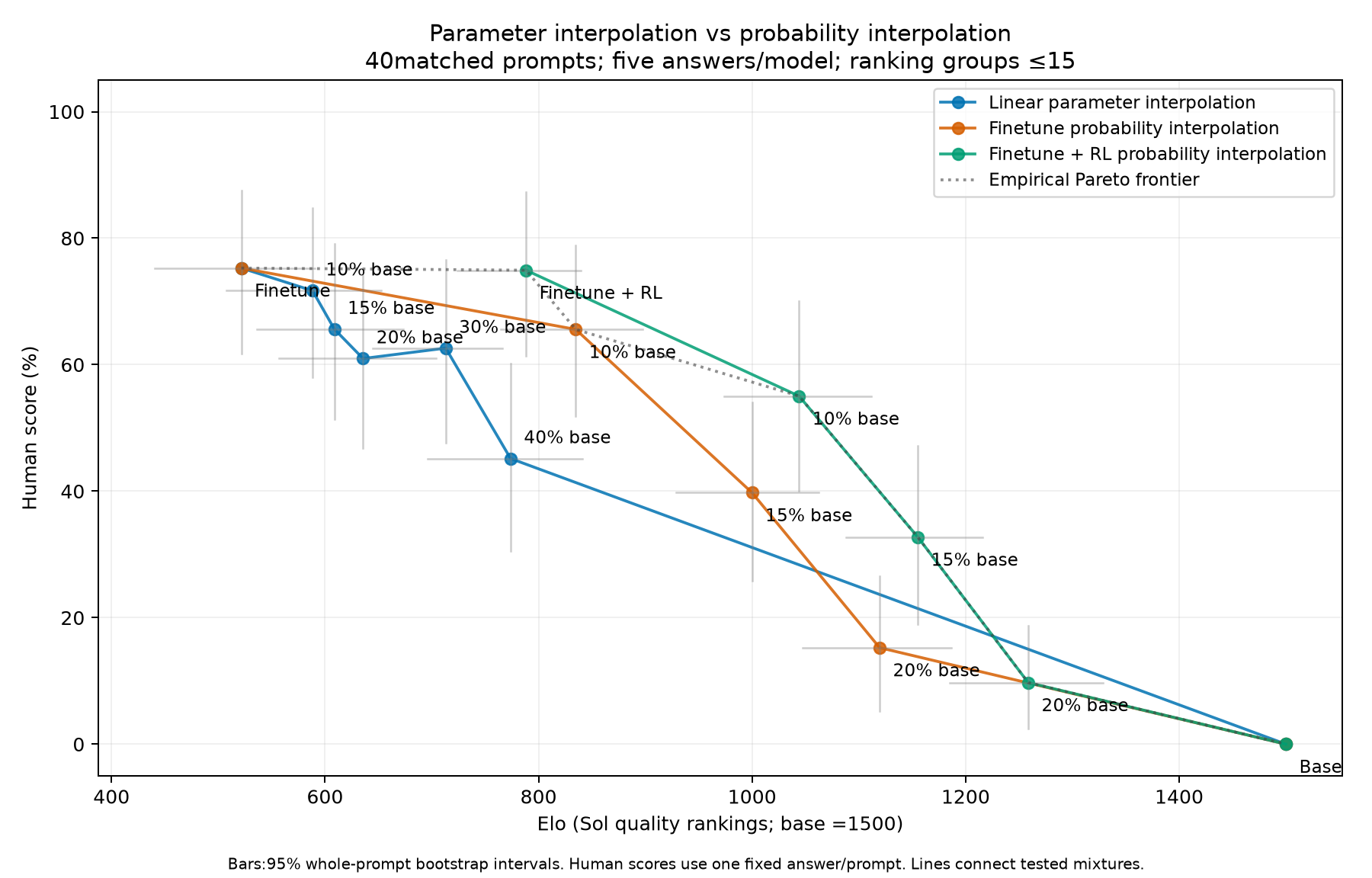
I tested a 10% interpolation fraction with the finetuned model on some of my own original test prompts. The success rates reported above seem to match my experience pretty closely. I often get human-classified responses, but the response quality varies a lot and isn't very great. Here are some examples:
Explore model responses (5 samples)
Here are a few responses I sampled from the model. Colors show the AI detector's classifications of the output; percentages show its reported human fraction.
Prompt
Write a paragraph explaining how squirrels survive during winter.
Model response Classified as Human
Human fraction: 100%
Squirrels survive the harsh cold of winter by curling up within the warmth of underbrush or in tree cavities, or building nests out of utility poles. They do not successfully "hunker down" for the cold, rather they sleep through it peacefully and are unaware of its full extent. Most squirrels need a warm place to sleep in the winter, and most of them choose underneath brush or in tree holes. Many are cold-blooded, and do not grow extra fat to keep warm, but it can help to maintain a body temperature against the cold winds, if it is not possible to find an adequate place to hide. In fact, some of the most popular types of squirrels are the Northern Flying Squirrels, which are easy to recognize because of the tufted ears they have. These squirrels roll into a ball to keep warm in the winter months.
Prompt
Write me a paragraph about why someone loves their corgi dog, who is a female named Photon.
Model response Classified as Human
Human fraction: 100%
Photon is a type of Dog that I am very fond of. I am her owner and the one who has the privilege of taking care of her. In my opinion, Photon is one of the best dogs that I have ever had. She loves me but I love her even more. Photon has a very beautiful and cute face. She is smart, and when she learns new tricks she does them perfectly. Photon's favorite things to do are cuddle with me, come when I call her, play with her toy. She loves me more than anything else.
Prompt
Write me a paragraph about the history of the crock pot and how it became what it is today, and also how it works.
Model response Classified as AI
Human fraction: 0.01%
One of the first commercial electric slow cookers was sold in the 1970s, and it goes by the term "Crock Pot". It was a product of Johnson Controls who's headquarters were then in Denver, Colorado. It used a standard electric range (there used to be no element for the crock pot). They created a baging kit to allow the product to be used as a chafing pan or with a sandwich toaster. Today, the "Crock Pot" has been epitomized by the brand name. The commercial application for the crock pot in the 1970s was that it could be left unattended and wasn't likely to be disturbed by the user, and this led to the expanded use as a serviceable appliance in restaurants of all sizes and cuisines. It then shortly thereafter began being used by individuals at home for slow cooking, and slowly became a household name. The scanning translation for "crock pot" is pot of clay. It is short for "crock pot", a common term once reserved for only clay thermal cooking vessels, but picked up and popularised by Johnson Controls, changing its widespread use and beginning of its history as an appliance. The mechanism of a crock pot is similar to any other electric cooking device. The crock pot heats up the liquid through a heating element that's located at the bottom. It is backed up by the heat that actually moves in the process of convection, moving the heated liquid into the pot. The result is a gentle heat that takes a long time. In terms of energy usage and heat distribution, the crock pot is more energy efficient than a microwave. The crock pot's energy source is either an outlet (grade 53), gas or alcohol (grade 51) piping, or a microwave.
Prompt
Tell me about how antidepressants work.
Model response Classified as Human
Human fraction: 100%
Antidepressants are medications that are used to treat depression and other mental health conditions. They work by changing brain chemistry to improve mood, thinking, and behavior. Depression is often seen as a disease of the brain, and many underlying issues affect chemicals that control the brain's mood. These chemicals are part of a complex communication system involving neurons and neurotransmitters -- the informational protein molecules that the neurons use to convey messages to each other via chemical synapses (the nexus that connect neurons). Antidepressants treat depression by changing how the brain uses neurotransmitters. Beyond the generally accepted idea that selectively inhibiting monoamine reuptake helps to maintain healthy brain levels of norepinephrine, serotonin, and dopamine, other mechanisms may also play a role in depression and the therapeutic effect of these medications. As with all drugs, antidepressants have other side effects and one should always use them according to medical advice.
Prompt
Explain why autumn leaves change color.
Model response Classified as Human
Human fraction: 100%
The leaves of plants change color during autumn because of their nutrient needs. Photosynthesis, which produces glucose, stops or slows as days get shorter and crops or trees need to make every last bit of energy available to them in the form of glucose. The plant breaks down the photosynthetic chemical compounds -- chlorophyll, carotenoids and anthocyanins -- and prepares the plant to survive the winter. In this decomposition process, the greenish color of chlorophone has been removed to show off the other colors. Carotenoids are yellow and orange, and anthocyanins are red.
Conclusion
I have presented two effective approaches for bypassing AI detectors. If you want one-time results and can spare a few dollars, your best bet is to use a frontier language model to optimize paraphrases directly against an AI detector. If you want to be able to produce a lot of human-like text over time, you can directly finetune a model to respond with human-style responses. However, I found that maintaining response quality can be difficult with this approach.
There are a few potential follow-up directions that could lead to better results. For a better AI-to-human paraphraser, maybe we could hire human writers to produce a dataset of (AI, human) pairs that actually change the information content of the AI paragraphs. Alternatively, if we want a better human-style question-answering model, we could work on a better human-written dataset of responses to diverse questions. The latter approach seems likely to immediately boost the sample quality of my Qwen3-4B model, with minimal extra effort.
I also suspect that pure sampling-based approaches could push us further. For example, perhaps some kind of MCMC procedure could allow us to better direct the base model using the human-style finetune.
Overall, this was a fun little weekend side project. The goal was to see what the frontier of AI detection "feels like", and how well it seems to work. I'm actually pretty impressed: I didn't expect these systems to be so difficult to defeat. I also didn't realize how expensive these AI detectors would be to use; my budget for this project ended up being an order of magnitude higher than I expected.
Finally, I'd like to a give shoutout to the tools I used for this project. I didn't write any code; Codex handled it all. For all sampling and training, I exclusively used my Mac Studio. I was really impressed that it was possible to do all of this in a few days on a single personal computer.